
What is the principle of seal detection equipment?Understand the secrets of science and technology in one article!
Understanding the principles of seal testing equipment is like peeling off the first layer of a technological onion.These devices allow us to ensure that every tiny hole in our product is flawless, thereby avoiding a host of headaches.Want to know how exactly these devices work?Please feel free to take a seat, make an appointment for three cups of coffee, and let’s discuss the secrets in detail!Today, Hirays will work with you to reveal the working principle of seal detection equipment and help you uncover the magical veil behind this technology.
1. The importance of seal detection
Whether you're manufacturing automotive parts, food packaging, or electronic devices, sealing is a critical piece of information that can't be ignored.For example, if your car door is not sealed, congratulations, water intrusion will become a daily worry for you!Not only that, poor sealing can also lead to air inflow, liquid leakage, etc., affecting the service life and quality of the product.The role of seal testing equipment is to help you discover these potential problems, thereby avoiding nightmare quality problems discovered after the product leaves the factory.
2. What is seal testing equipment?
Simply put, seal testing equipment is an advanced “detective tool” that helps us determine whether a product is properly sealed.It can quickly and accurately identify "leaky people" and "water leaking people" in products through a series of high-tech means.These devices usually use various methods such as air pressure, vacuum, resistance, etc. for testing to ensure that each product is "iron-walled" and never leaks air or water.
3. Principle of seal detection by air pressure method
The air pressure method is the most common type of seal detection.Its principle is like giving you a basketball and then continuously inflating it to see if any air leaks out.This method usually works by placing the product in a sealed container and then increasing the air pressure inside the container.If the product has any slight leaks, the reading on the air pressure gauge will change, allowing you to quickly identify the problem.In most industrial applications, this method is popular for its efficiency and accuracy.
4. Principle of vacuum seal detection
Compared with the air pressure method, the vacuum method is another more general method.This method is almost like "reverse inflation", where you first put your product into a sealed container and then evacuate it.If any air seeps into your product, congratulations, the sensor will immediately catch these "uninvited guests" and display a change in the reading.The advantage of the vacuum method is that it can detect smaller leak points, so it has been widely used in many fields with high precision requirements, such as aerospace and medical equipment.
5. Principle of seal detection by resistance method
The resistance method is a more alternative seal detection method, which uses resistance changes to check the sealing of the product.We place the product in a container containing conductive liquid and measure the changes in current inside and outside the product to determine whether there is a leak.This principle is like detecting whether a wire is open. Any small leakage of liquid will change the value of the resistance, thereby accurately finding the leak point.This method is particularly important in some specific application scenarios, such as the detection of waterproof electronic products.
6. Application case: Hirays sealing testing equipment
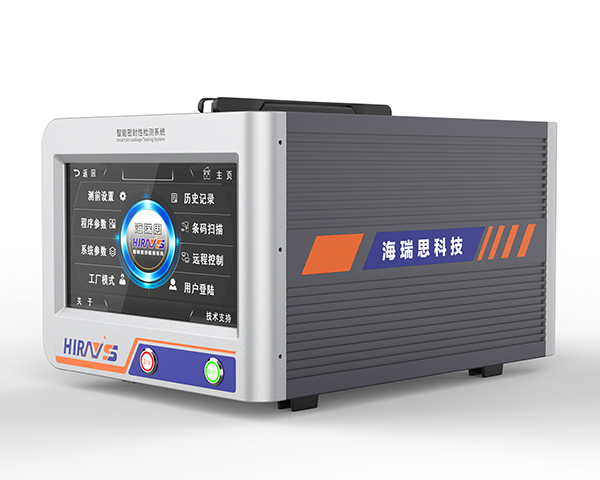
For example, Hiraysi's sealing testing equipment integrates a variety of testing methods, which is highly accurate, stable and reliable.Common applications include engines, gearboxes, doors and other components in the automotive field, as well as packaging sealing performance testing in the food and medical industry.The different modes of Hai Ruisi equipment can meet a variety of complex industrial needs. Its high efficiency and high accuracy make countless engineering and technical personnel feel at ease.Like a well-rounded friend who can deal with both the "big troubles" and the "little problems" in your life.
7. Future prospects
With the popularization of Industry 4.0 and Internet of Things technologies, seal testing equipment is becoming more intelligent and diverse.Imagine that through 5G technology, engineers can monitor every sealing link on the production line in real time, discover and solve problems in time.Hiraysi has also been committed to exploring new technologies and striving to continuously innovate in the field of seal detection.Looking forward to the future, sealing testing equipment can not only ensure product quality, but also further optimize the production process and reduce costs, making each product a flawless classic.
in conclusion
After knowing so much, do you think that seal testing equipment is really the "Sherlock Holmes" of the scientific and technological world?Indeed, these devices use high-tech methods to accurately detect the sealing properties of products and ensure stable quality.No matter which industry you are in, seal testing equipment will become your right-hand man.I hope this article not only opened your eyes, but also sparked your interest in high-tech equipment.If you also want to experience Hai Ruisi's sealing testing equipment, welcome to contact us and explore more mysteries of technology together!
-
2026.04.11Good News | Hirays Honored as "Most Investment-Worthy Enterprise" at 2026 AI Glasses China Tour
-
2026.04.11Why are more and more companies opting for RGA technology for power bank electrolyte leakage detection?
-
2026.03.30Commemorating the revolutionary martyrs and inheriting the red spirit | Record of hirays’s theme activity of walking to commemorate the martyrs’ cemetery
-
2026.03.20Starting from June, the sale of non-compliant power banks will be banned: many companies ignore this detection issue
-
2026.03.16After charging 70% in 5 minutes, how can the safety of the power battery be maintained?
-
2026.03.14Overcoming difficulties and showing responsibility, efficient delivery wins praise - a tribute to the four pioneer employees on the production front line
-
2026.03.03Comparison of mass spectrometry technology applications: How do Heris helium mass spectrometers and RGA series enable precision manufacturing?
-
2026.02.26Construction has started | hirays starts a new journey of struggle in 2026
-
2026.02.06Let’s work together to embark on a new journey | The 3rd hirays Fun Games was successfully held
